
The author is grateful to Selbi Durdiyeva and Zahro Ergasheva for their comments and support in editing, and for the friendship through words and images;
to Hanna Otchyk and Maria Vyatchina for their authorship and translation of crucial texts, for their precision, critical rigor, openness and gentleness of their writing, which served as example;
to the collectives of decolonial language and beda.media for the opportunity to discuss the texts of Adrienne Edgar and Nandita Sharma as part of the Nearby reading group;
to Elmira Kakabayeva and the participants of the course Family Ethnography: How to Decolonise Your Writing (Spring 2025) for giving me the courage to publish;
and to all of the above — for collective thinking and the opportunity to learn.
I was nine years old when we moved from Uzbekistan to Russia. By 'we,' I mean my family—my parents, my two older brothers, and me. It was the summer of 1996. In the fall, my brother—just a year older—and I went to the third grade at the school in a Siberian village with a population of 3000 people, even though we had already finished the third grade in Uzbekistan. The teachers decided that we wouldn’t be able to handle the next year’s curriculum because, according to them, “the schooling in Uzbekistan is worse”. Russian was our native language—we weren’t bilingual, and in our mixed family, only our father spoke Uzbek.
The experience of migration in childhood is a scar that runs through the entire body. The body itself is a scar. There aren't two halves separated by a wound — there is only the wound. I have read writers who lived on the border of states, in mixed, creolised, hybrid cultures — I searched their writing for plantain leaves to soothe my wound, but found none. Gloria Anzaldúa writes that she is both here and there. But I — and those like me — are neither here nor there. We lack the language of one culture, and carry the oppressor’s tongue of the other, and in the end, we are rejected by both.
I’m neither Uzbek nor Russian. My body is neither female nor male. I am a migrant and a queer person, and these transient identities are the most stable things I have.
Who does this experience make me within the field of decolonial activism in the post-Soviet and Russian context? Or am I out of place here too? I hold Russian citizenship — but which of my lands can I ask to be liberated, when in truth I have none. When I come to Uzbekistan, I become a tourist: a tourist on my native land, in my own family.
The ongoing Russian influence on Uzbekistan’s politics and economy, its racist migration policy toward migrants from Central Asia make it impossible to say that the history of colonial relations between Russia and Uzbekistan is over. In the postcolonial situation, states that have de jure gained independence from the metropole are de facto engaged in the same Great Game, albeit with a renewed set of players.
As Adrienne Edgar writes, the Soviet Central (Middle) Asia was a field of active nation-building that involved establishing new borders, codifying languages and “nationalities,” and consolidating them administratively and bureaucratically[1]. The national projects that emerged from below, from ethnic, linguistic and religious communities, as well as the local efforts to modernise culture and politics — such as Jadidism and Islamic feminism — were destroyed[2]. Instead, the Soviets imposed a single model of modernity and “nationality”. It is important to note — and I am grateful to the editor of the text for pointing this out — that during the period of Korenizatsiia ( can be translated as ”indigenization” or “nativization”), the alliance between national movements in the region and the Soviet authorities had a significant impact on how the borders, languages, and national self-determination of the peoples of the region were formed. However, this alliance was possible to a certain extent and only until the Bolsheviks had consolidated their power sufficiently to no longer need allies from among the “national intelligentsia.”
This policy led to ethnic conflicts, territorial disputes between Uzbekistan, Kyrgyzstan, and Tajikistan, and the persistence of the land and people hierarchies established in Soviet times.
Thus, the Tajik Soviet Social Republic became a separate republic as part of the Soviet Union in 1929, having previously held a status of an autonomous republic within the Uzbek SSR. Its republican status guaranteed Tajikistan statehood after the collapse of the USSR.
While Karakalpak ASSR changed its “affiliation” with larger administrative units several times: from 1932 to 1936 it was part of the Russian SFSR, from 1936 to 1990 it belonged to Uzbek SSR, from 1990 to 1992 — to USSR. This resulted in Karakalpakstan remaining within Uzbekistan and being effectively deprived of political autonomy.
The protests of 2022 in Nukus and other cities in the republic against the constitutional amendments that proposed stripping Karakalpakstan of its autonomy and the right to secede from Uzbekistan were brutally suppressed. According to the officials, 21 people were killed by the police. However, human rights defenders estimate that between 55 and 77 people died during the protests[3]. Three policemen were convicted for "illegal actions during the demonstrations”[4], yet none of those who gave the orders to open fire were held accountable.
The Soviet’s legacy in the region continues to fuel violence, but the actors carrying it out are now different. Independence didn’t lead to the rejection of old hierarchies or the reflection on what interethnic and interstate relations in the region might look like, but to the usurpation of power by the same type of individuals who had held it during the Soviet times. The strengthening of nation-states, nation-building, and authoritarianism has become a bitter response to the lies about brotherly peoples and internationalism — the lies that masked the imperial power and colonisation in the Soviet Union.
Is there really no alternative other than choosing between empire and nation-state? If everyone around insists that there is no choice, it means that this choice is simply inconvenient. To move beyond this deadlock, one needs to turn to the region’s history. Before the colonisation of Central Asia by the Russian empire, the principles behind community building and political associations were different. The concept of a nation in its modern sense didn’t exist. For many peoples of the region, their belonging to familial or tribal communities was more important. There were also supranational communities — religious and cultural ones. Islam, along with the Arabic, Persian and the Turkic languages — the languages of literature and science — united people within and beyond the region. For the sedentary population, affiliation with political centers — khanates and cities — was more significant than ethnic identity. For the nomadic people, the connection to the land and the routes of migration played the key role.
The Russian empire and later the Soviet Union, driven by their inherent metropolitan obsession with accounting, structuring, and categorisation of living people and lands, repeatedly drew and redrew the borders of the administrative units and ethnic groups throughout the entire period of the occupation of The colonial names of the region include the Turkestan Governor-Generalship and the Turkestan Krai (Turkestan Region) during the Russian Empire, and Central Asia in the Soviet times. As Zahro Ergasheva pointed out in the comments on the draft of this text, the term "Turkestan" is also problematic, as it overlooks a multitude of ethnic groups inhabiting the region, not all of whom belong to Turkic peoples. For instance, Tajiks, Pamiris, Dungans, and many other peoples belong to other linguistic and ethnic groups. ignoring the actual social relations.
And in the end aren’t we forced to bitterly admit that this project on nation-building was, perhaps, their greatest success? That today’s sovereign states of Central Asia are its products? And like any nation state they too are also built on social exclusion.
Сitizenship, whether or not it’s linked to “nationality”— however nationality and nation may be understood — separates those who belong (i. e. who hold citizenship) from others (migrants and refugees). As the supporter of no border movement Nandita Sharma writes, “[In Postcolonial New World Order] being a Migrant is seen as having no lawful claim to territory, livelihoods, or political membership.”[5]
In the Siberian village we moved to, only the indigenous people of that land were treated worse than the migrants. Perhaps this is because in a world obsessed with the idea of the nation, those whom colonial powers have deprived of the ability to practice alternative ways of understanding the world, are also denied the right to political subjectivity. Their subjectivity is limited to the imposed notion of being a “minority.” In colonial vocabulary, “a minority” means: “We came to your land, killed your defenders, imposed our rule on you, and settled in such numbers that we could convince ourselves it has always been this way — just as in the version of history we brought with us.”
Russia is an example of the convergence of expansive imperial logic and national chauvinism, and this seeming paradox tells us everything we need to know about both. An empire is built through an expansion of borders, through occupation of ever new lands, and is guided by a logic of inclusion. A nation-state is built on the exclusion of “others” under the slogans of defending the interests of “its own.” For an empire, there are no others, for a nation-state others are essential. How, then, is their combination possible? An answer may be found in a Russian propaganda slogan from 2022—the year the full-scale invasion of Ukraine began and the ideology of the “Russian world” came on full display: “I am Kalmyk, but today we are all Russians.”
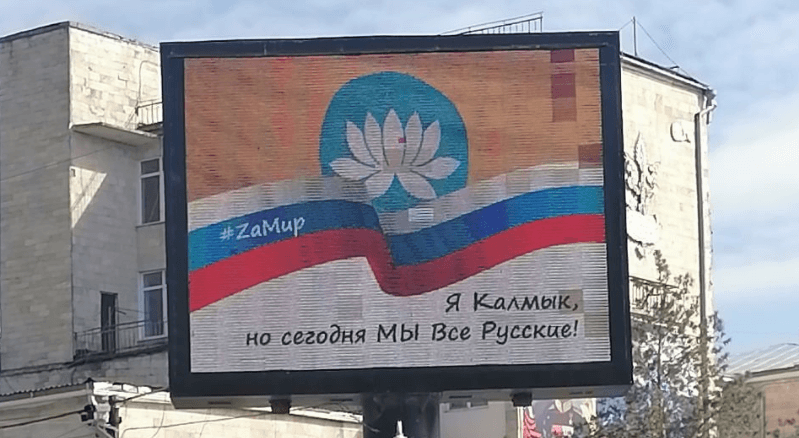
This absurd phrase reveals the unconscious of a nationalist empire. Existence of the Other is possible, but only in an act of denying one’s own subjectivity, only in an act of marking oneself as subaltern, only from the position of negating or diminishing one’s otherness. This also explains the incoherence of the ideological justification for the invasion of Ukraine. Propaganda simultaneously claims: “There is no such thing as a Ukrainian nation,” “Russians and Ukrainians are one people,” and “All Ukrainians are Nazis”, “All Ukrainians are enemies.” Russia’s hatred of Ukraine is revenge for its refusal to submit, for its unwillingness to be subaltern. The same can be said of Israel and Palestine; of Azerbaijan and Armenia; of Turkey, Syria, Iraq and Kurdistan.
Imperial nationalism is the name of our modernity.
So how do we move beyond it, and toward what future?
Amid this celebration of borders and registrations, into which the world has been transformed by the The widespread use of visa regimes between countries began after the First World War as a way to restrict migration. Before that, visas were mostly a formality — in most parts of the world they were issued at border crossings and functioned primarily as a registration of foreign citizens, without placing real limits on entry. after the First World War, people without a citizenship (those deprived of one or who have never had it) and people without a state (Roma, Uyghurs, Kurds, and many other—also labeled as “minorities” in the places they inhabit) appear as a living question mark. A question is to what authority they can appeal to when no administrative units stand behind them. A question about how effective administrative units are when they are turned to for the protection of rights, for support, for care.
Aren’t the borders, states, and entry regimes that thread through the world first and foremost perpetrators of violence?
What if those like me and many others, who don’t know to which land they can turn to for their roots, let go of this longing and allow ourselves to see what our bodies have long known — that a world free of colonial legacy and globalised coloniality can only be a world without borders?
What if knowledge of history, of ancestors and roots does not equal the search for blood purity — if identities are not rigid cells, but guiding lines that shift depending on a variety of factors, including our own choices? What if we see ourselves as the ancestors of one another—both in the present and in the future—as those who influence, support, and shape each other? What if differences are as important as commonalities, as are the things we do not yet know about ourselves and each other?
What if the convergence of the abolitionist movement, that opposes police violence, visa regimes, and refugee camps, and the decolonial movement, that advocates alternatives to the multitude of colonialisms and imperialisms, is both urgent and necessary if we want to unite in liberation rather than retreat into isolation?
What if liberation can only be demanded for the entire land, for all who inhabit it, traverse it, or seek refuge and a home?
What if we imagine a world in which the memory and honoring of traditions—restored, erased, or killed by colonial powers—were combined with the abolition of the hierarchies these powers created?
What if there is a place for everyone in this world?