
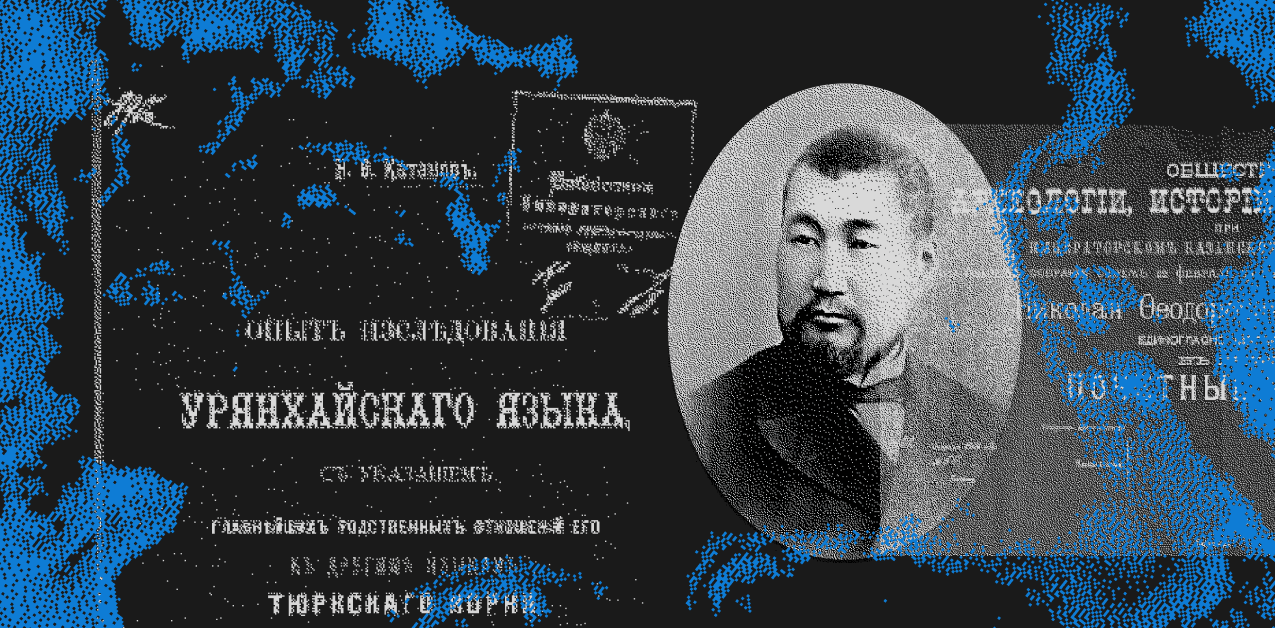
Academic Journey: Beginning
“My name is Nikolai Fedorovich, and in Tatar: “Porá” means “gray-haired” in Khakas. While I. Kokova notes that, according to family legends, the newborn had a gray forelock,[12] T. Garipov proposes translating the name as “Wolf”.[13] However, these two interpretations are not necessarily contradictory.” — Nikolai Katanov begins his autobiography for the Encyclopedic Dictionary of Imperial Russia’s Writers and Scholars[1]. This single sentence reveals paradoxes of Russian colonial history. By saying “in Tatar,” Katanov reminds us that in pre-revolutionary Russia that could refer to virtually any tongue of the Turkic language family. The parallel use of a local name given within the Indigenous community and a Christian name intended for official documents and any formal occasion was another colonial practice.
The future scholar was the youngest child in the family of the Uluses were administrative units and settlements that existed in Khakassia under the rule of the Russian Empire. scribe Fyodor Katanov from The Sagays are one of the local groups of the Khakas people. and Maria Kizekova (Khakas name: Chamakh) from The Kachins are one of the local groups of the Khakas people. of This refers to the clan — söök in Khakas — called Puryut, meaning that she traced her lineage to a man named Puryut. clan.
During the warm half of the year I lived with my parents at the summer camp in the Sagay steppe, open on all sides, and during the cold half of the year I lived at the winter camp on the very bank of the Abakan near Lake Sarkagel. Near the winter camp there were hay meadows. In summer I herded sheep and calves with the other children.[2]
His father died early, and the boy was raised in the household of his uncle who served as a local bureaucrat. Efim Katanov, his uncle, was listed as a clerk of the local council, a shopkeeper, and a Christian church elder. On one occasion he conducted a collective baptist ceremony converting his fellow villagers into the Russian version of orthodoxy — “up to 3,000 non-Russians,” and, for this effort, he was awarded a medal from the state.[3] Christianization was both a goal and a tool of the imperial administration’s policies toward all non-Russian populations of the Russian Empire. While Russian officials engaged in complex debates regarding followers of Islam as a monotheistic religion, Indigenous groups practicing shamanism and communicating with spirits of rivers, mountains, forests, and sacred sites were subjected unequivocally to forced assimilation and baptism.[4]
Katanov is usually described as the first professor of Khakas origin. Yet, it would be unfair to omit the fact that within the entire Russian Empire he was only the second scholar of “non-Russian” origin to be appointed to official academic status — not merely in the sense of conducting research, as many others did, but in possessing a rank conferred by collegial decision and approved by the imperial bureaucratic apparatus. This is important to highlight because between these two figures — Nikolai Katanov and his predecessor Alexander Kazembek (1802–1870) was born into the family of Hadji Qasim, a high-ranking Shi‘i preacher from Derbent, and Sharaf-Nisa, the daughter of the governor of the Qajar Iran city of Rasht. Kazem-Bek (also rendered as Kazem Bek or Kazem-bek) received a comprehensive home education and converted to Christianity at the age of nineteen under the influence of Scottish missionaries. His conversion from Islam, knowledge of both European and Eastern of languages, and brilliant reputation as a teacher and translator made him highly sought after in the educational institutions of the Russian Empire. Kazem-Bek began his career as an instructor at the Kazan Boys’ Gymnasium and at Kazan University, and in 1841 he was appointed to Saint Petersburg University to head the Faculty of Oriental Languages, which had been transferred there from Kazan. — lies a significant gap shaped by ethnic origin, The Scottish missionaries who influenced Kazembek’s conversion to Christianity were representatives of the Edinburgh Bible Society. In 1802, they established the Karass colony near Pyatigorsk before later relocating to Astrakhan. Their primary mission was the translation and distribution of Christian literature in local languages., family wealth, and integration into the mainstream of nineteenth-century high society.
In 1869, at the age of seven, Katanov was enrolled at a newly opened school in the village of Askiz. After completing his primary education there, he traveled nearly 500 kilometers by boat along the Abakan River to reach the provincial center of Krasnoyarsk, where a teacher-training seminary and a boys’ gymnasium were located. The next stop on his long journey to formal education was Saint Petersburg University, which he completed with distinction despite constant financial hardship. His talent, perseverance, and accumulated knowledge made him one of the most outstanding students of the Faculty of Oriental Languages. The university professorship he dreamed of seemed within reach.
Between 1889 and 1892, Katanov conducted extensive field research in Siberia, Mongolia, and Northern China. This work was supported by a scholarship from the Russian Geographical Society and the Academy of Sciences, as he was being prepared as a candidate for a professorship. However, the reaction within university circles exposed prevailing colonial attitudes. Although Katanov fulfilled all the formal requirements for the position, members of the University Academic Council not only rejected his candidacy but also sent a letter to the Ministry of Public Education arguing that Katanov should instead work in Kazan to devote himself to educating Inorodtsy — the official imperial term for non-Russian subjects at that era — people “like himself.”
Kazan and Alienation
This brief account explains how Katanov ended up in Kazan. While many intellectuals pursued careers in Moscow and Saint Petersburg, Kazan functioned as a key operational center for preparation and implementation of state policies. Directives may have been drafted in the ministries, but it was in Kazan that they were enacted — or, at times, quietly undermined.
Even in Kazan, however, Katanov encountered significant obstacles. He was appointed to Kazan University with the status of “extraordinary professor” in Turkish-Tatar languages — a lower-ranking, non-tenured position largely confined to elective courses. An extraordinary professor was expected to constantly prove his loyalty, and the rank carried a reduced salary. This partly explains why Katanov had to take on any available side work, including translations, forensic examinations, and service in the state censorship department.
At the same time, a part of the local intellectual community was unwilling to accept that a non-Russian from a remote region could occupy an equal place in their milieu. Some reacted with sneers: “Soon they will start sending us savages” [5]. In an ironic gesture, Katanov adopted the pen name Д.И.К-ий (rus. cyr.). for his journalistic publications — a clever play on the Russian word for Savage — дикий (dikiy, dikii). In personal correspondence, he described the difficulty of overcoming the condescension of university professors dissatisfied with the emergence of a new cohort of Indigenous scholars within the Society of Archaeology, History, and Ethnography (OAIE). University intellectuals complained that at Society meetings — where Katanov served as academic secretary from the time of his arrival in Kazan — “mere dilettantes” were presenting reports on compiling dictionaries, recording legends in their native languages, and documenting archaeological discoveries in their home villages.
Yet, Katanov’s efforts bore fruit. Today, virtually every account of the OAIE acknowledges the democratization of the Society’s research activity in the early twentieth century.
Scholarly Work
Katanov devoted his dissertation to a linguistic description of the Tuvan language, then known as Uriankhai[6]. Drawing on his vast linguistic expertise — biographers claim he worked with more than 140 languages — he demonstrated that Tuvan belongs to the Turkic language family despite significant Mongolian influence. In particular, he compared his collected Tuvan materials with data from forty-seven Turkic languages, including Chagatai, Altai, Azerbaijani, Crimean Tatar, and even the language of the Mariupol Greeks. The two-volume dissertation received wide recognition in academic circles.
In total, according to various estimates, Katanov authored at least 320 publications. Dozens of unpublished manuscripts remain in extensive archival collections across several cities and countries. The nearly ten-thousand-volume collection of books and manuscripts that he sold in 1912 laid the foundation for the Institute of Turkological Studies at Istanbul University. Katanov actively purchased rare items and donated them to museums and libraries. His gifts continue to enrich exhibitions in many cities, including museums in his native Abakan and Minusinsk.
Katanov through the Eyes of His Contemporaries
We will likely never know what Katanov felt as he confronted injustice in an era when the concept of racism had not yet been clearly formulated. Humor helped him respond to racist incidents. As Barashkov-Epchelei recounts, once an official at the wharf mistook Professor Katanov for a porter. Saying, “Certainly, Your Excellency,” Katanov carried the suitcase to the ship’s cabin and calmly pocketed the tips he earned. A few hours later, he appeared at dinner wearing the uniform of a Katanov received the rank of Actual State Councillor in 1915., according to his status. Attempting to apologize, the official asked for the coin back, but Katanov refused: “I earned it fair and square!”
Another episode, from a trip to Europe, was portrayed in a letter from his friend and colleague Nikolai Karl Adolf Anderson (1845–1905) was a linguist specializing in Finno-Ugric languages who worked alongside Katanov as an extraordinary professor at Kazan University.. “He was walking down the street with a Russian acquaintance from Kazan when some Italian, glancing at N.F., loudly declared to his companion with the air of a connoisseur, ‘Look, Chinese!’ Not missing a beat, N.F., pointed at the man from Kazan and said, ‘Look, Siamese!’”[7]
The perseverance his work demanded required incredible restraint and silent patience from Katanov. In a letter to a friend, he wrote about his work in Kazan: “As a lecturer, I must wage a persistent struggle against the prevailing opinion here that ‘the Inorodtsy are doomed to extinction and therefore (!) should not be studied.’”[8]
Rare testimonies from those close to him mention his feelings. Zeki Velidi Togan (1890–1970) was a historian and turkologist of Bashqort origin. recalls bitter advice that Katanov gave him, perhaps in a moment of emotional vulnerability: “Among the Mongols and Eastern Turks, three men entered the path of Oriental studies — Dorzhi Banzarov, Chokan Valikhanov (1835–1865), also spelled as Shoqan Walikhanov, was a Kazakh scholar, historian, ethnographer, folklorist, and educator., and I. Each devoted himself entirely to Russian literature. I renounced shamanism and became a Christian; I serve their science. Chokan and Dorzhi died because of vodka before reaching thirty-five, as our Russian colleagues taught us nothing but heavily drinking. You will be the fourth man in our lineage — but please be aware of it.”[9]
After the two revolutions of 1917, Katanov continued scholarly work alongside his colleagues: teaching in educational institutions, supporting students and younger colleagues, engaging in museum work, and rescuing valuables that might otherwise have been looted. In 1921, during the famine in the Volga-Ural region, Katanov’s life came to an end.
Criticism
During the Stalinist period, a decade after his death, Katanov’s name began to be used as a shorthand for conservative scholarship. Just about everyone at that time wrote about “Katanov the monarchist” or “Katanov the reactionary”[10]. Yet the professor himself never publicly endorsed any political regime, expressing his position in other ways: whenever possible, he offered support and assistance to fellow Indigenous scholars. The Turkic scholar Zeki Velidi wrote in his memoirs that his first book on Tatar history was published precisely because the censorship procedure was handled by Katanov and Nikolai Ivanovich Ashmarin (1870–1933) was a linguist of Chuvash origin. He was known as a close colleague of Katanov..[11]
It was only in the late 1950s that the first memoirs openly challenging this entrenched negative image were published.
Katanov is often reproached for his teaching and his publishing at A higher theological educational institution of the Russian Empire that existed from 1797 to 1818 and again from 1842 to 1921.. Yet through his example, he showed the Academy’s non-Russian students that they could engage freely with knowledge of their native languages: recording speech samples, compiling textbooks, and conducting comparative research. The journal An educational journal published between 1912 and 1916 in cooperation with Kazan University. (“Review of the Non-Russian Peoples”), whatever officials at the Ministry of Public Education might have thought of it, became a valued platform for timely discussions of educational problems and women’s rights, earning admiration among its readers. Others question his involvement with the Temperance Society, associated with The Black Hundreds were a group of ultranationalist far-right organizations active between 1905 and 1917 that promoted autocracy, Orthodoxy, and Russian nationalism. organization. It should be noted, however, that beyond combating the effects of alcoholism, as a disease, Katanov actively and extensively contributed articles on pressing social issues to Deyatel’ (“The doer”), the journal published by the Society. This suggests that he did not forgo opportunities to speak out where he could express his views without censorship.