
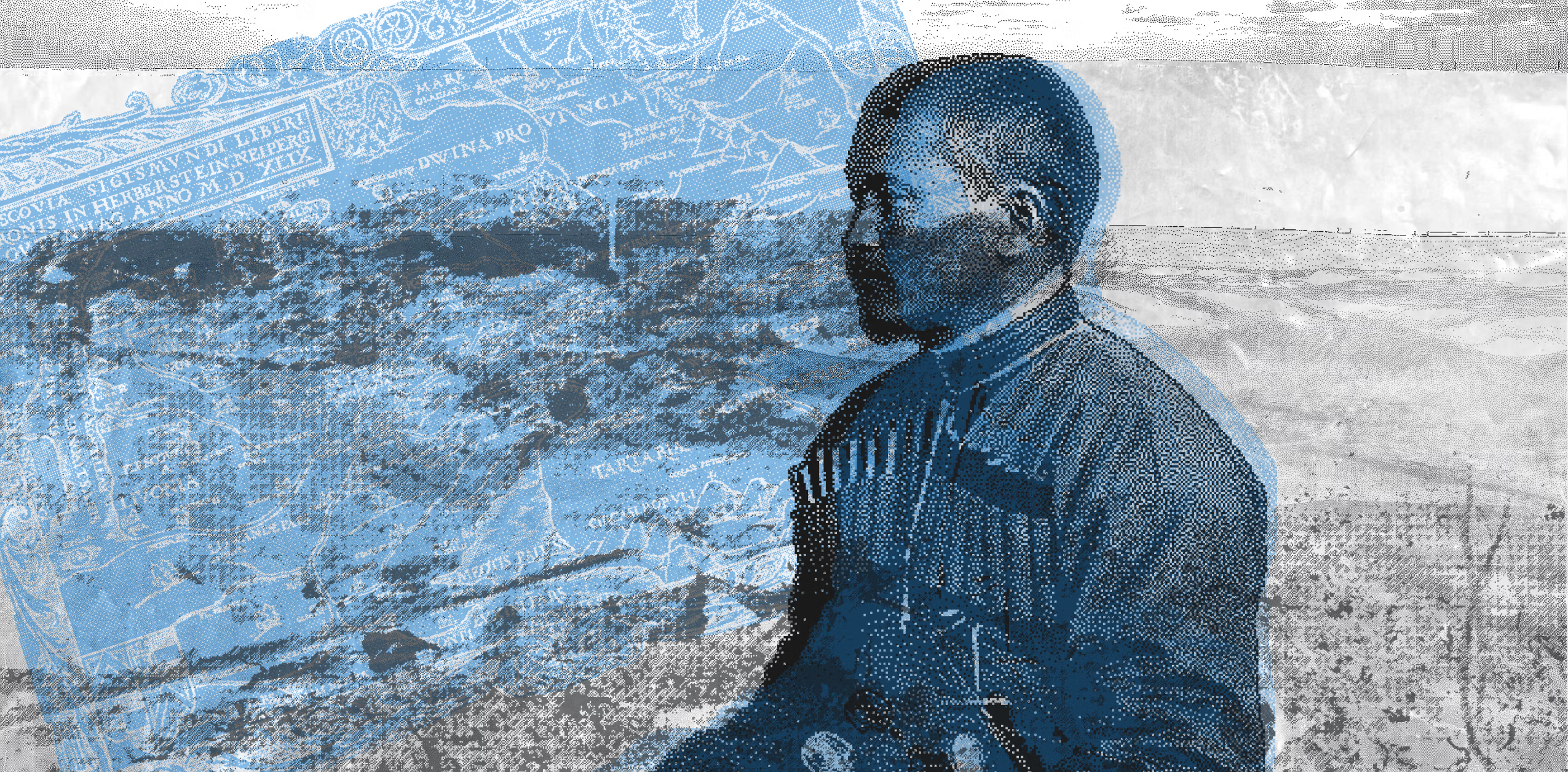
The Nogai are one of Russia’s Turkic-speaking peoples, scattered across various lands, but united by their love of freedom in their native steppe. Centuries of living in the steppe have given the Nogai people a firm understanding that the land needs to rest, and therefore herds must be moved from place to place every few years. During this break, the steppe restores its fertile layer. But in recent decades, the opposite has been happening: the land is being plowed and trampled, the steppe is thinning out every year and masses of sand are rapidly increasing.
For the Nogai, the steppe is life, their native element, pastures, places of memory, and the graves of their ancestors. For federal and regional officials, what the steppe today is becoming the source of a mass of uncomfortable questions, a result of misunderstanding the basic principles of land use and a disregard for traditional knowledge and the context of local relationships.
Erosion, desertification, loss of natural vegetation cover, soil degradation—there are dozens of terms to describe what is happening scientifically. But what words can describe the grief of people for whom the steppe is home?
(Not) on the Map
The Nogai Steppe is located between the Terek and Kuma Rivers. “Nogai” refers to the historical area of settlement, bringing together what has been ripped apart and divided among different regions of today’s administrative-territorial units.
According to M.A. Volkhonksky, and A. A. Yarlykapov, the Nogai Steppe comprises the north of the Republic of Dagestan (Nogai, Kizlyar, and Tarumovsky Districts), the north of the Republic of Chechnya (Shelkovsky and Naursky Districts), the east, southeast, and part of the southern Stavropol Territory (Neftekumsky, Stepnovsky, Kursky, and Kirovsky Districts, the southern parts of Levokumsky and Georgievsky Districts, the eastern parts of Budennovsky and Sovetsky Districts), the north of the Republic of North Ossetia (the north of the Mozdok District) and northeast Kabardino-Balkarian Republic (most of the Prokhladnensky District, minor parts of the Maisky and Baksansky Districts).[1]
All these are regions where the Nogai have historically lived in the North Caucasus and Ciscaucasia for the last 150–200 years, united by a single, well-established name: the Nogai Steppe. Today there are increasing attempts to move away from this term. For example, officials prefer to use Kizlyar Steppe. There are several problems with this simulacrum name. Let us cite just one from a long list describing Kizlyar’s role in Russian military expansion. In government documents, Kizlyar was called “Russia’s capital in the Caucasus.”[2] Calling the steppe by this name is not only a sign of disregard for indigenous peoples and history, but also of the foresight of those who intended to deprive people of their memory of their connection to their land.
What remains today on the official political map in just one name—the Nogai District of the Republic of Dagestan—stirred the imagination of Russian imperial administrators until the mid-19th century.
Pressed Between Two Empires
Before the Nogai Steppe, there was the Desht-i-Kypchak. In connection to this name, which translates as the Kipchak Steppe, uniting all the steppe lands between the Danube and the Irtysh, the Nogai Horde appears in medieval historical documents. Coincidentally, historians refer to the Nogai Horde during its period of power as a nomadic empire, emphasizing not its monarchical form of government, but the scale and concentrated resources of the nomads during this period.[3] However, neighboring states soon began displacing the Nogai. In the mid-18th century, two empires (empires precisely because of their monarchical power and colonial aspirations), the Ottoman and Russian, saw the descendants of the Nogai Horde as both a desirable ally and simultaneously a treacherous enemy. Both tried to use the Nogai in their complex diplomatic games.
What just yesterday were ancestral nomadic lands became considered the territory belonging to two empires, and the Nogai had to a pick a side. The Russian authorities promised the murzas that they would retain their tribal privileges, which ultimately secured military careers for the noble Nogai in the ranks of the Russian Army. Of course, it is not possible to briefly describe the reasons the Nogai became one of the Russian Empire’s foreign peoples. There were a series of agreements and their violations, violence and forced displacements.
One event in this series is commemorated today as the Nogai people’s Day of Remembrance and Mourning for those who died in the Kermenchik Massacre. In mid-late 1783, the Nogai, having learned of yet another plan to relocate them, refused Russian citizenship and initiated military resistance. On October 1, 1783, under the command of General Suvorov, Russian troops attacked the rebels’ camp, completely destroying it and taking 1,000 men and an unknown number of women and children hostage. For several more weeks, the military searched the steppe for survivors in order to take revenge on all the survivors. At least 7,000 people died. In total, during the hundred years from 1720 to 1820, the Nogai diminished by 350,000 to 500,000 people.
After the Russo-Turkish War of 1828–1829, the Treaty of Adrianople incorporated all the territory from the Kuban to the Black Sea into the Russian Empire. The Nogai of the Kuban were formally converted to Russian citizenship. In 1857–1861, at the end of the Russo-Caucasian War, some Nogai were The history of the forced resettlement of the Nogai people is part of the history of muhajirism (mass resettlement of Muslim peoples) in the Ottoman Empire. As a result of the Russian Empire’s conquest of the Crimean Khanate in the 18th century, the colonization of the North Caucasus, and the Russo-Caucasian War, many peoples: the Nogai, Circassians (Adyghe), Abkhaz, Abaza, Chechens, Ingush, Ossetians, and others became muhajirs. to the Ottoman Empire along with the rest of the surviving Muslim population. Russian officers and officials wrote about this fact with regret, believing that the Nogai could have been useful to the Russian throne. The Russian authorities resettled those who remained on the territory of present-day Karachay-Cherkessia.
At each stage of their forced adoption of Russian citizenship, the empire divided Nogai people among military districts. Already at the end of the 19th century, officials appointed to govern the Nogai Steppe began discussing the extent of soil erosion in the territory entrusted to them and proposed specific measures to combat it. The cause for concern was the immediate threat to the Achikulak A district was an administrative-territorial unit of the Russian Empire in the late 18th and early 20th centuries. It corresponded to counties in terms of territory and were formed to govern the Muslim population in the Caucasus and Central Asia. An official, known as a district administrator, was appointed to govern this territory, and his place of residence was called a district headquarters. and the roads silting up with sand. It is important to remember that roads were part of the colonial administration system. Local residents could manage without, while the functioning of the administrative apparatus was practically impossible without them. The officials, however, justified their requests not in terms threats to themselves, but as “the destructiveness of the sands to the socioeconomic development of the local population.”[4] Again, they blamed locals for the nuisance, namely “mismanagement by local nomads, manifested in the merciless destruction of shrubbery on the sands and excessive grazing of livestock on poor sandy soil.”[5]
In 1895–1898, officials proposed establishing plantations to “passify the sands,” the seedlings from which could be planted in various areas of the Nogai Steppe. These plantations mainly grew sheliuga (bushwillows), as well as white acacias, oak trees, and osiers. The nuance was that the state forced the Turkmen communities also nomadic in this area to financially support sand containment measures. Not surprisingly, this financial burden raised reasonable questions among the Turkmen.
Around the same time, the Nogai began to adopt sedentarization, according to official reports in the archives. However, mass transition to a sedentary lifestyle emerged from deliberate actions the Soviet authorities took. In the 1920s, the Soviets inititated measures to forcibly settle the Karano-Nogai and Achikulak Nogai peoples. These measures entailed cruelty, confiscation of livestock, and destruction of nomadic dwellings. As a result, there were no camels left on the Nogai Steppe and the Nogais’ horse breed was exterminated.
Simultaneously with forcing the Nogai to settle, Soviet officials began transferring mountain dwellers to the steppe,[6] a process that subsequently intensified in the 1960s.[7] There was a system of animal husbandry according in which Dagestanis drove their livestock down to the plains (kutany) in winter and migrated to luxuriant mountain pastures in summer. According to official data, 15 Dagestani mountainous regions used 80% of the land resources of the Nogai region for grazing.[8] Initially, this measure involving forced relocation of people, animals, and farms, was a temporary one,[9] but became permanent for many families that remained on the plains and did not return to their mountain villages. The breeding of new livestock breeds, abundant fodder crops, and intensive wool production all took place at the pace of Soviet Five-Year Plans under the noisy slogans of the Soviet government. As the numbers in the reports grew, the steppe, buffeted by dry winds, shrank and disappeared.
Transformations
Everything occurring on the Nogai Steppe today directly or indirectly impacts the process of desertification. There is so much sand from dry winds that highways and dirt roads must be relocated because passenger cars cannot easily navigate the sand accumulations and dunes. Local residents are convinced that people who lease steppe land for livestock grazing easily circumvent land use regulations and thus deplete the fertile layer, which is replaced by sand and rapidly expanding salt lakes. Salinization occurs not only because of the composition of the soil, which is prone to this process: the wind carries salt deposits from the coast without hindrance. To be more precise, the wind carries 56 tons of salt per year from each kilometer of the Caspian Sea coastline.[10]
Sandstorms echo these changes to nature, covering Makhachkala, Stavropol, and other cities.[11] Water disappears from its usual sources. Hydrocarbon production infrastructure, both officially registered and informal, occupies part of the Nogai Steppe. Oil production has been going on here since the 1960s. But today outsiders who, according to local residents, rarely think about tomorrow, do most of the work.
You may have noticed, at the very beginning of this essay, I noted that the Nogai Steppe is the historical homeland of the Nogai people. In recent years, Nogai men looking for work have begun migrating to the north, particularly to the Tyumen Region, later moving their families to join them.[12] At the same time, planning to return in the future, they use the money they earn to build new houses in their native villages and help their fellow villagers, although they do not always know when their returns will occur.
Without Autonomy
In 1996, Dagestan adopted “On the Status of Grazing Lands,” which links together many of today’s contradictions. Under this legal act, a third of all Nogai Steppe lands first became the property of the republic and then ended up in private hands. In 2017, the public learned about a land reform project in Dagestan aimed at legalizing all the mountain settlements that had appeared on transhumant livestock farming lands. For the Nogais, this would mean both the loss of their lands and the symbolic loss of their majority status in the Nogai District.
It is impossible to understand the overall picture without one important fact: the Nogai people, numbering over 100,000, have no political autonomy. For many decades, the Soviet authorities promised to revise the administrative boundaries so that the Nogai would receive at least some land with self-governing status. Not only did this land fail to materialize, but as 2017 showed, even the land in the region—the only region the name of which symbolically preserves the name of the Nogai people—became the subject of machinations by officials who, covering up past wrongdoings, seek to commit new ones.
Realizing the rapid scale of the loss of their steppe, the Nogai tried to coordinate all the power of the diaspora. In June 2017, a Congress of the Nogai People was held in the village of Terekli-Mekteb. The elders reburied the remains of their ancestors whose graves had been exposed by the movement of the sands. By a decree of the congress, the people tried to draw public attention to this problem. Dagestan’s land reform project contradicted other legislation and was thus withdrawn from consideration. The latest All-Russian Population Census demonstrated the influence of social cohesion. The Nogai became one of the few ethnic groups to demonstrate an increase in number. While in 2010, 90,000 people identified as Nogai, in 2021, this figure rose to 109,000. The reason, according to researchers, is not a sharp increase in births or longevity: for a long time, Nogai were recorded as Tatars and Kazakhs, and in the latest census, many were able to correct this categorization.[13]
Attempts to replace the name Nogai Steppe with other names are becoming more frequent and the regional and federal governments refuse to recognize the extent of the ecological disaster. The question of the status of land in the Nogai Steppe and that of the lack of autonomy remain open.
Translated by Helen Faller.